

You might not think about your floors daily, but everyone will notice when they look dull, worn, scratched or neglected. Routine maintenance, including stripping and waxing, is a crucial component of how your facility presents itself.
Most floors need service anywhere from a few times a year to once every couple of years, depending on how much traffic they get. A strategic, customized maintenance plan helps your floors last longer, reduces surprise repairs and prevents premature replacement.
Factors That Influence Your Floor Care Frequency
To avoid the risks that come with improperly maintained flooring, you should create a comprehensive commercial floor care program based on these variables.
Foot Traffic Volume and Type
Traffic intensity directly affects floor degradation. As people walk across your floors, they’ll wear away the protective finish. They may also track in dirt and debris.
Foot traffic isn’t the only consideration for facilities such as warehouses and hospitals. Rolling equipment like pallet jacks, hand trucks and mobile carts creates additional abrasion, necessitating more aggressive maintenance schedules, including floor waxing and stripping.
Floor Material
Floor materials have varying maintenance needs.
-
Vinyl composition tile: The most prevalent commercial flooring, most VCT flooring responds well to regular stripping and waxing. High-traffic areas typically need service every three to six months, while low-traffic zones can go up to 18 months.
-
Luxury vinyl tile: Typically more durable than VCT, LVT often features a wear layer that reduces wax frequency. Many installations need stripping only once or twice a year.
-
Rubber flooring: Resilient and low-maintenance, rubber floors typically need annual stripping and waxing. Some high-performance rubber requires even less frequent service.
-
Sealed concrete: Popular in commercial settings, sealed concrete needs periodic resealing rather than traditional wax. Depending on sealer type and traffic, reapplication should occur every one to three years.
Some specialized surfaces like terrazzo require expert assessment to determine appropriate maintenance intervals.
Desired Level of Appearance
Beyond the physical characteristics of your floors, your aesthetic standards are also influential. A corporate lobby where clients form first impressions demands a mirror-like finish maintained through frequent burnishing and stripping cycles. Conversely, a warehouse floor prioritizes durability and safety over aesthetics, allowing longer intervals between refinishing.
Higher gloss standards require more frequent intervention. To create a realistic schedule and budget expectations that help you achieve your appearance standards, define your appearance threshold up front.
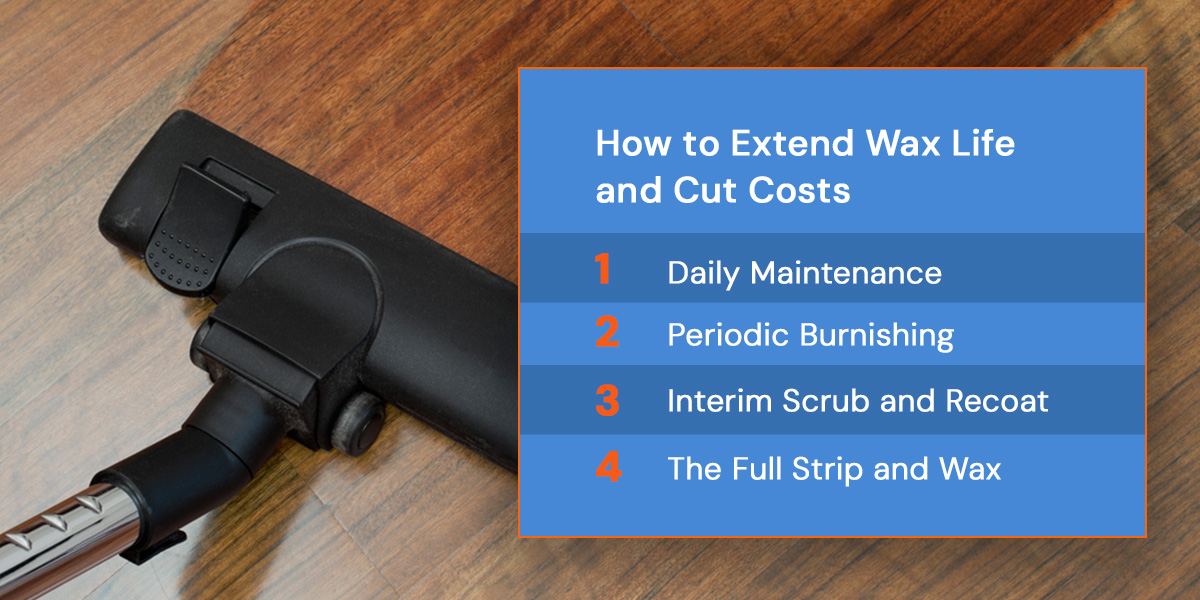
How to Extend Wax Life and Cut Costs
A comprehensive floor-care plan preserves a glossy appearance and lets you extend the time between strip-and-refinish cycles without compromising appearance or protection. Longer maintenance intervals save money, reduce downtime and keep your facility looking consistently well-maintained.
Your program needs structure. Breaking it into four tiers gives you a predictable rhythm for daily, routine and interim tasks, all designed to delay the final restorative step while maintaining high standards.
1. Daily Maintenance
Daily maintenance is foundational. Dust mopping and immediate spill cleanup remove the abrasive particles that prematurely degrade the finish. Upkeep also has multiple benefits.
- Reduce the risk of slips and falls: Wet, dirty or dusty floors create hazardous conditions. Preventing slips and falls reduces liability claims and employee absences.
- Enhance your reputation: It only takes seconds to form a first impression. Clean floors communicate that your facility is tidy and well cared for.
- Eliminate bad smells: Floor soiling creates unpleasant odors that regular cleaning can prevent.
- Cut costs: Light daily maintenance costs less than intensive deep cleaning. Extending the time between major procedures protects your bottom line.
2. Periodic Burnishing
When daily maintenance can’t keep up with your demands, burnishing is your next line of defense. This fast, undisruptive process reheats and hardens the existing finish, removing scuffs and restoring gloss without removing wax layers, which can prolong the interval between strips.
Professional floor polishing or burnishing should occur monthly or quarterly, depending on traffic.
3. Interim Scrub and Recoat
Even with diligent daily care and regular burnishing, the top layers of finish will start to fail, necessitating scrub and recoat maintenance. This procedure removes only the top damaged finish layers through mechanical scrubbing, then applies fresh coats to restore protection and appearance.
Unlike full stripping, scrub and recoat preserves the foundational finish layers, often adding six months to a year between refinishing cycles. Since it’s less extensive, this method is cheaper than a full strip and wax.
4. The Full Strip and Wax
Eventually, even the best maintenance program reaches its limits. When interim maintenance can no longer restore acceptable appearance and protection, a full strip and refinishing is necessary to reset the floor to optimal condition.
This procedure removes all existing finishes, addresses underlying floor damage and rebuilds complete protection from the substrate up.
What Is the Professional Floor Stripping and Waxing Process?
Each step involved in floor stripping and waxing requires specific knowledge, equipment and techniques. This entire process can take days or even weeks to complete, largely due to the necessary curing times.
- Preparing the floor: Professionals secure the work area through signage and physical barriers. The floor undergoes initial mopping and scraping to remove hardened debris like gum before chemical application.
- Applying the stripping solution: Workers evenly apply the solution, allowing it to remain on the surface to penetrate and loosen existing layers. The chemical dwell time is typically 10 to 15 minutes, but this varies by solution, floor material and finish condition.
- Mechanically scrubbing and detail edging: Once the solution loosens the finish, mechanical scrubbing equipment removes softened layers. Edge tools and floor scrapers address corners and tight spaces where machines cannot reach.
- Removing the slurry and neutralizing the surface: Pros extract the resulting slurry using wet-and-dry vacuums or similar equipment. Multiple rinses ensure no residue remains, while a pH-neutralizing solution restores proper floor chemistry for new finish adhesion.
- Applying sealer and multiple finish coats: After letting the floor dry, professionals apply three to five coats of finish, letting each coat cure fully before the next application.
- Final curing and high-speed burnishing: Once all finish coats cure completely, high-speed burnishing hardens the layers and creates the glossy appearance that signals proper application and protection.
5 Signs Your Floors Need a Full Strip and Wax
Pay attention to these telltale symptoms that indicate your floor is due for a complete strip and wax.
- Yellowing or discolored finish: Light maintenance is no longer sufficient to remove dirt and contaminants that have penetrated the floor material.
- Visible wear patterns and scratches: Permanent marks show that protective wax layers have worn through, exposing vulnerable substrate to accelerated damage.
- Flaking, peeling or chipped finish: Surface damage reveals failing floor protection that needs removal and replacement to prevent substrate deterioration.
- Unpleasant odors: Musty or foul smells emanating from flooring often result from residue trapped in degraded wax layers that standard cleaning can’t address.
- Increased cleaning difficulty: Failing protective layers are the culprit when dirt embeds more easily or stains appear more readily.
Partner With Clean MD Commercial Cleaning

A practical floor maintenance strategy is the secret to saving time and money on frequent stripping and waxing. With an OSHA and IICRC-certified team and years of experience, Clean MD is the perfect partner for businesses in Western New York who want the best maintenance solution for their floors. Let us help you maximize your investment with daily maintenance protocols and comprehensive strip-and-wax procedures.
Contact us today to learn how we tailor solutions to your business and floors.